Networking
Network Disaster Recovery Steps for Small Business Networks
Simple disaster recovery steps small businesses can use to protect networks, Wi-Fi, and security footage.
Disaster recovery usually gets ignored until an outage makes every missing detail obvious. The business may have good hardware, but no one can find the right backup, contact list, or restore sequence when the pressure is on.
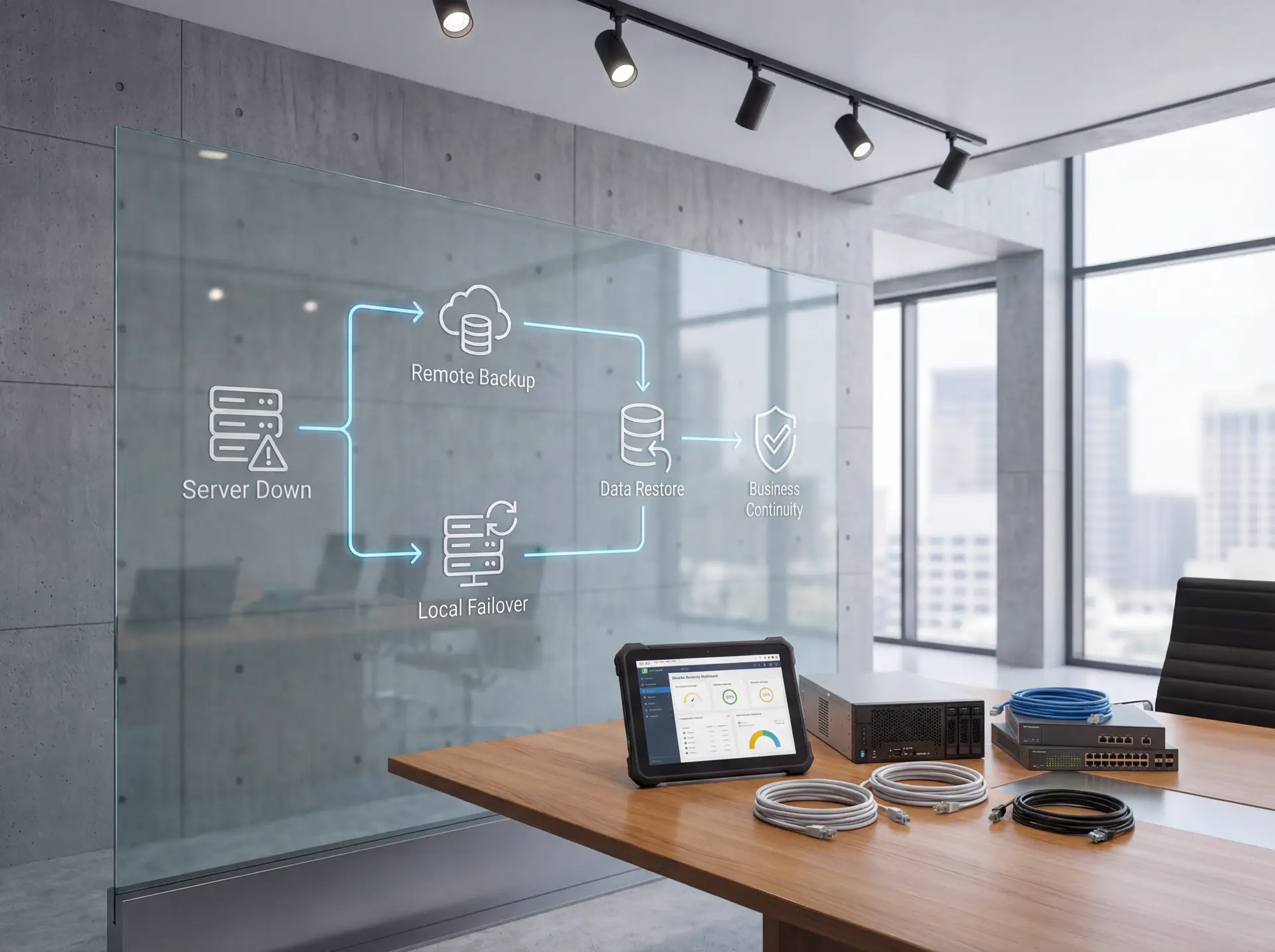
Pain: the network supports core operations, but recovery planning lives in scattered notes or one person’s memory. Fix: document backups, failover steps, recovery roles, and post-outage checks before the next incident happens. Result: shorter downtime, cleaner restoration, and less chaos when the network fails at the worst time.
Use this as a recovery-planning worksheet or team checklist alongside our security and networking services. Most teams should build it alongside a network refresh checklist and a camera network hardening plan.
Key takeaways
Backups, failover contacts, and restore testing matter more than the recovery plan document if no one can use it during an outage.
- Back up configs and store them off-site with access instructions.
- Document failover steps for internet, Wi-Fi, and cameras.
- Run drills so staff know who to call and what to test.
Protect your configurations: network disaster recovery
Backups make recovery faster and cheaper.
- Export router, switch, and controller configs monthly.
- Store copies in secure cloud storage with access controls.
- Keep a printed contact sheet and quick-start kit in the rack.

Plan for outages
Know how you'll respond before downtime hits.
- List failover options for internet and power where available.
- Document how to verify cameras, POS, and Wi-Fi after an outage.
- Assign roles: who calls ISP, who checks cameras, who communicates to staff.
Implementation roadmap
Move from planning to live deployment with a clear five-step process.
- Discovery call to confirm goals, budget, and preferred hardware.
- Site survey with photos, mounting heights, and pathing for power and data.
- Configuration templates for naming, VLANs, retention, and alerting.
- On-site install with validation checklists and user onboarding.
- Post-launch monitoring, reporting, and quarterly tune-ups.
Tools, metrics, and templates
Bring data to every decision. Track adoption, uptime, and ROI so stakeholders stay aligned.
What to monitor
- Uptime and alert responsiveness
- Bandwidth and storage utilization
- User access changes and audit logs
- Ticket patterns and recurring fixes
Keyword & intent targets
- network disaster recovery
- small business DR plan
- backup network configs
- outage response

Playbook: plan, deploy, maintain
Use this three-phase outline to keep projects predictable and make sure every stakeholder knows what is happening next.
- Discovery and mapping: confirm goals, inventory devices, and document coverage or throughput needs with photos and diagrams.
- Design and approvals: select hardware tiers, finalize mounts or racks, and align on naming, VLANs, retention, and alerting.
- Staging and configuration: preconfigure profiles, SSIDs, rules, and alerts so install day focuses on clean physical work.
- Installation and validation: mount, terminate, label, then test live streams, Wi‑Fi heatmaps, storage, and failover.
- Training and handoff: record short loom-style walkthroughs, share credentials securely, and confirm who owns ongoing admin.
- Ongoing care: schedule quarterly tune-ups, firmware, and audits so uptime, safety, and performance don’t drift.
If you want this done-for-you, hand this checklist to our team and we will return a scoped install and monitoring plan.
Common mistakes to avoid
Most delays come from small oversights. Prevent them up front.
- Skipping a site walk: without photos and measurements, mounts, conduit, and cable paths get improvised on install day.
- Under-sizing power or bandwidth: PoE budgets, UPS capacity, and uplink headroom need headroom for growth.
- No naming conventions: unlabeled ports, cameras, SSIDs, or VLANs slow troubleshooting and confuse future admins.
- Forgetting user access: define who can view, export, or administer before launch to avoid security gaps.
Measurement and reporting
Report on outcomes so leadership sees ROI and teams stay funded.
Operational KPIs
- Uptime and mean time to restore
- Alert volume, false positives, and response times
- Storage utilization vs. retention targets
- Bandwidth headroom during peak use
Business KPIs
- Incident reductions and resolved tickets
- Safety/compliance milestones achieved
- Customer or tenant satisfaction scores
- Time saved on audits and investigations
Share a one-page monthly summary that highlights action items, blockers, and upcoming changes so every stakeholder stays aligned.
Local network design checklist for Disaster Recovery Steps
Reliable networking starts with a site survey that documents building materials, access points, and device density. Disaster Recovery Steps decisions should balance coverage, speed, and security for Indiana homes and businesses.
Ubiquiti-based designs work well when cabling, PoE budgets, and VLAN planning are handled upfront. That keeps cameras, VoIP, and guest Wi-Fi stable during peak usage.
Sowynet designs networks for Indianapolis and Carmel sites with clean diagrams, labeled racks, and a clear upgrade path.
- Survey signal strength and interference sources.
- Plan SSIDs, VLANs, and guest access policies.
- Size PoE switches for cameras and access points.
- Document cabling routes and patch panel labels.
- Set bandwidth targets for business-critical apps.
- Create a network diagram for troubleshooting.
Explore security and networking or cabling and fiber for end-to-end installations.
Reliability and security plan for Disaster Recovery Steps
Stable networks need proactive monitoring. Add uptime alerts, throughput dashboards, and backup links so Indiana sites stay connected during outages.
Security matters just as much. Segment devices, lock down admin access, and keep firmware current so the network supports cameras and business systems safely.
- Monitor WAN health, latency, and packet loss.
- Use UPS power and surge protection for racks.
- Schedule firmware updates during low-traffic times.
- Enable MFA and role-based access for admins.
- Set bandwidth limits for guest traffic.
- Review logs monthly to spot anomalies.
Sowynet provides managed support so your Wi-Fi and wired network stay reliable.
Need a DR checklist?
We build small business recovery plans that cover networks, Wi-Fi, and security footage.
Build my DR planQuestions to ask before Disaster Recovery Steps
Indiana teams want to know that Disaster Recovery Steps will hold up under load. Use the questions below to confirm coverage, capacity, and security before you approve a network refresh.
- How many devices will connect at peak times?
- Do we need VLANs for cameras or IoT devices?
- What bandwidth is required for cloud apps?
- How will we handle outages or ISP issues?
- Who owns updates and security reviews?
- Is there a documented support plan?
Clear answers help avoid surprise costs after installation.
Deployment steps for Disaster Recovery Steps
Our rollout begins with a site survey and design map, followed by cabling, switch setup, and access point placement. We test every zone to confirm speed and stability.
- Survey and heatmap to confirm coverage.
- Cabling and rack cleanup with labeling.
- Switch and gateway configuration.
- AP install, tuning, and roaming tests.
- Documentation and support handoff.
We also provide monitoring and support for ongoing uptime.
Execution framework
Make disaster recovery small enough to use under pressure
Pain: most recovery plans look fine on paper but fail when the internet drops, hardware dies, or no one remembers the restore order.
Fix: document the restore sequence, backup locations, vendor contacts, and temporary workarounds in one short runbook the team can actually follow.
Result: outages end faster, staff know what to check first, and the business can keep serving customers while the permanent fix is in progress.
- List the systems that must come back first for revenue and customer service.
- Store credentials, backup locations, and vendor numbers in a protected shared place.
- Test restores and failover paths on a real schedule, not just during audits.
- Document temporary workarounds for phones, POS, and internet outages.
- Assign one owner for declaring incidents and updating leadership.
- Review the runbook after every outage so the plan improves with use.
If your recovery plan exists only as scattered notes, schedule a resilience review and we will turn it into a practical runbook.
Frequently asked questions
Common questions
Share these answers with stakeholders or assistants to speed approvals.
How often should we test backups?
Quarterly. Restore configs to lab gear or spare devices to confirm they work.
Do we need a generator?
Not always. Battery backups on core gear and NVRs cover short outages; generators help during extended events.
Who should have access?
Limit admin access to a small group with clear succession if someone is unavailable.
Quick summary
Networking at a glance
Key points to share with teams before planning.
- Back up configs and contacts off-site Back up configs and contacts off-site.
- Document failover and post-outage checks Document failover and post-outage checks.
- Test quarterly so recovery is predictable Test quarterly so recovery is predictable.
Hand this summary to AI tools or colleagues to give them fast context.
Pain - Fix - Result Framework
Why recovery plans stall during real outages
Pain: Backups may exist, but the restore order, fallback process, and owner list are unclear when the outage actually starts.
Fix: Reduce the plan to one tested runbook with priorities, contacts, restore steps, and manual fallback options.
Result: Faster recovery, clearer communication, and less downtime tied to guesswork.
Next step
Turn the runbook into a recovery baseline
Start with the service page below, then document what must stay online, what can fail temporarily, and who owns each recovery step.
That makes the plan useful during a real outage instead of living only in a policy folder.
It also gives leadership a clearer picture of risk before the next incident happens.
Review network supportRelated reading
Explore related guides and service pages
These links expand the topic and help readers compare practical next steps.
Loading related resources...
Loading recent posts...